
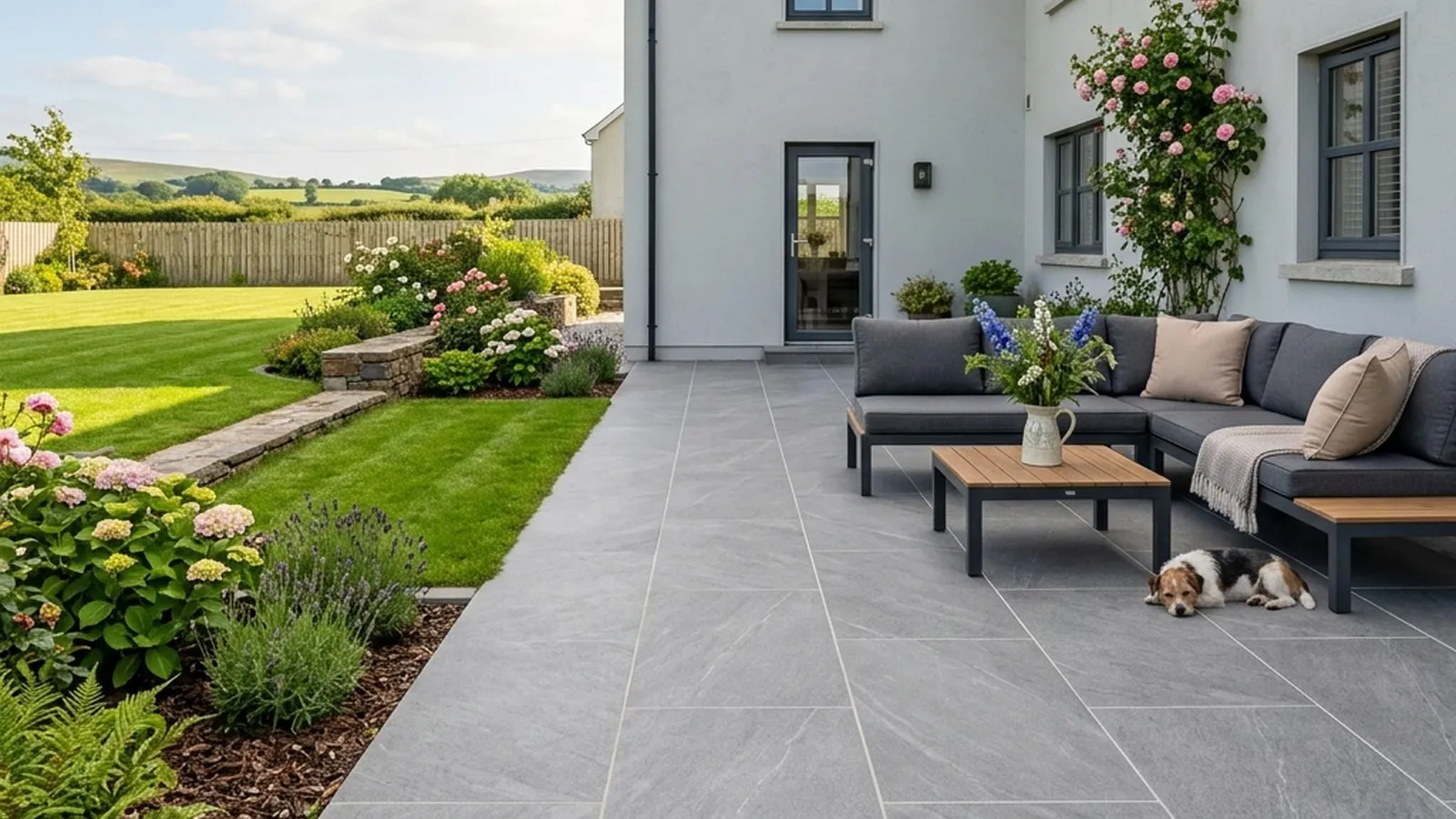
Budget from an itemised quote for your own property. Confirm the specification, site preparation, VAT and exclusions before comparing prices. The scope below identifies work to price; it is not a current national price average.
A new patio is one of the better-value outdoor upgrades in Ireland, and pricing is driven mostly by the paving material and the groundworks beneath it. These are guide figures only — get at least three written quotes for your own site.
Patio cost per m² by material (project-dependent quote items)
The table below shows indicative 2026 supplied-and-laid costs, i.e. materials plus labour and standard bedding/pointing. Material-only prices are lower but exclude the groundworks that make up a big share of any patio bill.
- Concrete slabs
- Poured / stamped (imprinted) concrete
- Natural stone — sandstone
- Natural stone — limestone
- Natural stone — granite
- Porcelain
- Block paving
Prices vary by region, contractor, site access and finish. Always confirm whether a quote is supply-only or supplied-and-laid before comparing.
What you are actually paying for: base preparation and groundworks
A patio is only as good as the base under it, and groundworks are often the largest single cost — and the part cheap quotes tend to skimp on.
- Excavation and spoil removal — the old surface and topsoil are dug out to depth; removing existing concrete or heavy vegetation costs more, as does poor access for a digger or barrow.
- Sub-base — a compacted layer of crushed hardcore (typically MOT/Cl.804) gives the patio its load-bearing foundation. Skimping here causes sinking and cracking later.
- Laying bed — slabs are set on a mortar or sand-and-cement bed; porcelain is usually laid on a full mortar bed with a primer slurry.
- Drainage and falls — the surface must be laid to a slight fall (around 1:60–1:80) so water runs off and away from the house, ideally to a lawn, soakaway or channel drain.
- Edging and pointing — edge restraints stop slabs spreading, and jointing/pointing seals the gaps. Block paving needs kiln-dried sand or a jointing compound.
A level back garden with clean access and natural drainage costs noticeably less to pave than a sloped, overgrown or hard-to-reach site.
Do you need planning permission?
For a normal domestic patio in your rear garden, you generally do not need planning permission — paths, ponds and patios within the curtilage of a house are typically exempt, as long as you do not alter the ground level by more than one metre above or below the adjoining ground.
The main exception is large hard-surfacing of a front garden that drains onto the public road. Since planning circular guidance from 2008, front-garden surface water should not discharge to the public road — so use a permeable surface, grade runoff to a lawn or planted area, or connect to a surface water drain. The same rule that catches paved driveways applies here, so if your project covers a sizeable front garden, read our note on driveway and dropped-kerb planning before you start. If in doubt, ask your local authority for a Section 5 declaration.
Landscaping extras
Patio quotes often exclude the finishing touches that make the space usable, so budget separately for:
- Steps, retaining walls or raised beds where the garden slopes.
- Channel drains, gullies or a soakaway on poorly draining sites.
- Lighting, power points and a path linking the patio to the house.
- Turf reinstatement, planting or a low boundary wall.
- A pergola, screening or — if you are building out a bigger project — a garden office.
These can add several hundred to a few thousand euro, so make sure each quote states exactly what is and is not included.
Ways to save
- Choose a simple shape. A rectangular patio minimises cuts and waste; order about 10% extra material for breakages.
- Mind the material. Concrete slabs or budget sandstone deliver the lowest supplied-and-laid cost; porcelain costs more up front but saves on long-term sealing and cleaning.
- Combine works. If you are also doing a driveway or a wider full house renovation, bundling groundworks with one contractor can cut mobilisation costs.
- Improve access. Clearing a route for machinery and skips reduces labour hours.
- Get at least three written quotes for your exact site, each itemising excavation, sub-base, drainage, edging and finish — that is the only reliable way to compare.
These are project-dependent quote items to help you budget, not fixed prices. For related outdoor projects, see our guides to driveway costs and garden room planning permission.