
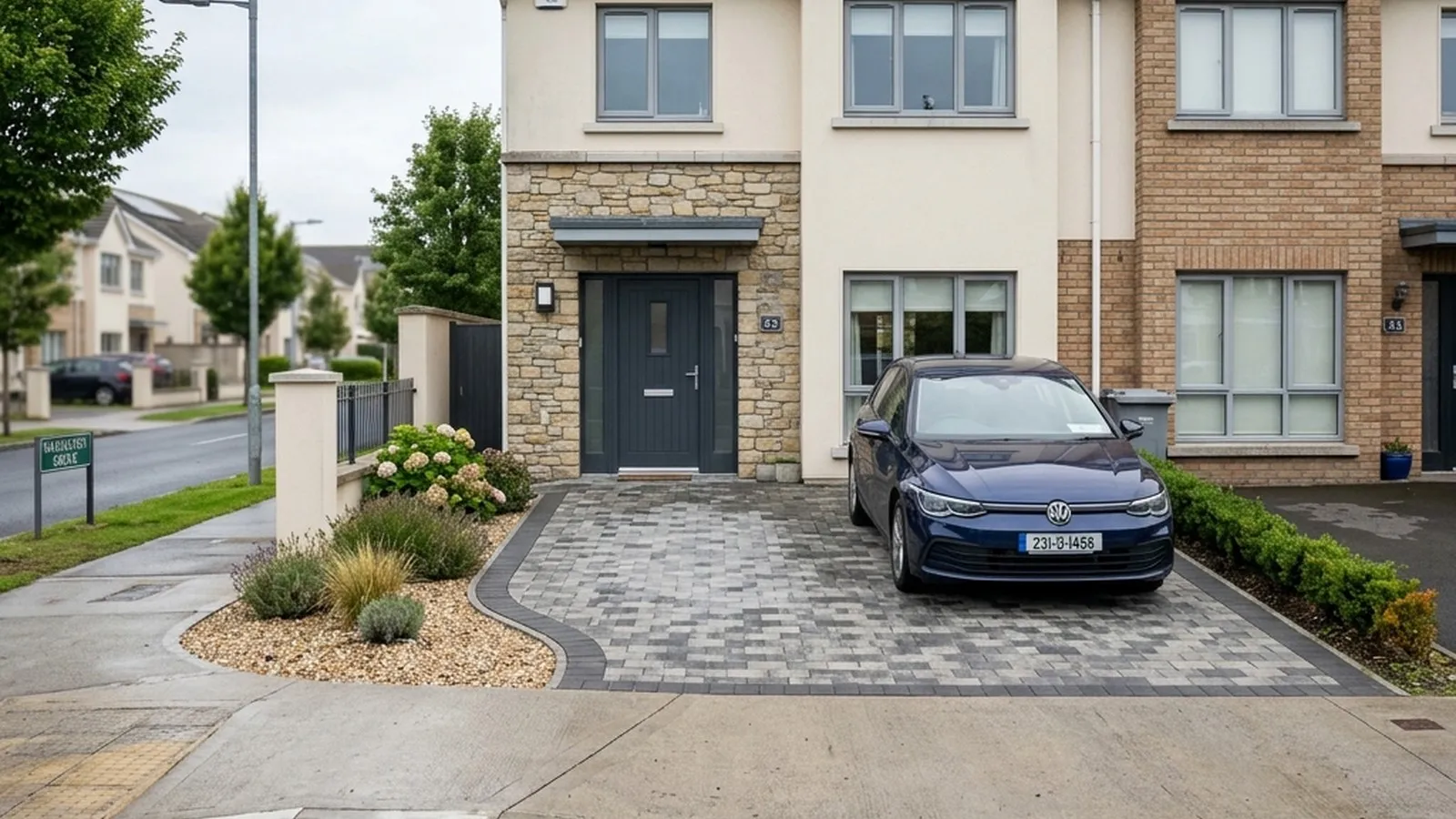
Thinking about a new driveway? In Ireland the planning trigger points are almost always front-garden hard-surfacing and creating or widening a vehicular entrance onto a public road. A back-garden patio for ordinary domestic use generally needs no permission. The two things to get right are drainage (rainwater must not run off onto the public road) and the dropped kerb, which is council-controlled work you cannot carry out yourself.
A quick disclaimer
This article is general guidance, not legal advice. Planning law is applied case by case and local authorities interpret it differently. Before you spend money, confirm your specific situation with your local authority’s planning and roads departments. If you want certainty, you can apply for a Section 5 declaration (see below), which gives you a formal ruling on whether your works are exempt.
Paving the front garden & SuDS
Laying a hard surface in your front garden for parking is often exempted development, but it comes with an important condition that has applied since 2008: surface water from the new or extended driveway must not discharge onto the public road. If rainwater would sheet off your tarmac or concrete and run onto the footpath or carriageway, you can need planning permission.
The straightforward way to stay within the exemption is to use a surface that manages water on your own property — the SuDS (Sustainable urban Drainage Systems) approach. In practice that means:
- Permeable block paving that lets water soak through joints.
- Resin-bound gravel or loose gravel.
- A sealed surface that drains to a soakaway within your boundary rather than to the road.
Permeable surfaces also reduce local flood risk, which is why councils such as Dublin City Council actively encourage them. Note that rear and side patios for everyday garden use are normally not a planning issue at all — the scrutiny is reserved for front gardens and anything that affects the public road.
The dropped kerb / new entrance process
To bring a car from your driveway across the public footpath you need the kerb and footpath lowered (dished) to council specification. This is not optional and not DIY:
- Council-controlled works. The footpath and kerb are public property. The works must be done by the local authority or by an approved contractor working under the council’s conditions, and the council’s area engineer must inspect and approve them.
- Application and fee. You apply to the roads department for a road-opening / dropped-kerb licence and pay a fee. Fees vary by council, so confirm the current amount.
- A bond is often required. Many councils ask you to lodge a security bond to guarantee the footpath is reinstated to standard if anything is damaged.
- Sight lines and safety. The council will assess visibility and road safety. A new entrance must give adequate sight lines in both directions; poor visibility, proximity to a junction, or loss of on-street parking can all lead to refusal.
Treat that purely as a ballpark and confirm fees and the bond amount with your council — published figures differ widely between local authorities.
When permission IS needed
You are most likely to need full planning permission where:
- You form a brand-new vehicular entrance, or widen an existing one, onto a public road. The exemption for an access is limited — for example, a surfaced carriageway access wider than about 4 metres falls outside the exemption and needs permission. Widening an entrance is frequently not exempt.
- Your home is a protected structure or sits in an Architectural Conservation Area — almost any change to the front, including the driveway surface, is likely to need consent.
- The front-garden surface drains to the public road rather than to a soakaway or permeable surface within your property.
- The entrance affects a national or regional road, where Transport Infrastructure Ireland and the council apply stricter access standards.
Gates and gateways up to 2 metres high are generally exempt, but that exemption does not cover forming the entrance itself.
How to apply / Section 5 declaration
If you are unsure whether your driveway or entrance is exempt, you have two routes:
- Section 5 declaration. Under section 5 of the Planning and Development Act 2000, anyone can ask the planning authority for a formal declaration on whether works are exempt. This is the cheapest way to get certainty before you build.
- Full planning application. If permission is required (a new or widened entrance, a protected structure, or drainage to the road), you lodge a standard planning application.
Either way, talk to both the planning and the roads departments early — the dropped-kerb licence is handled separately from planning, and you may need both.