
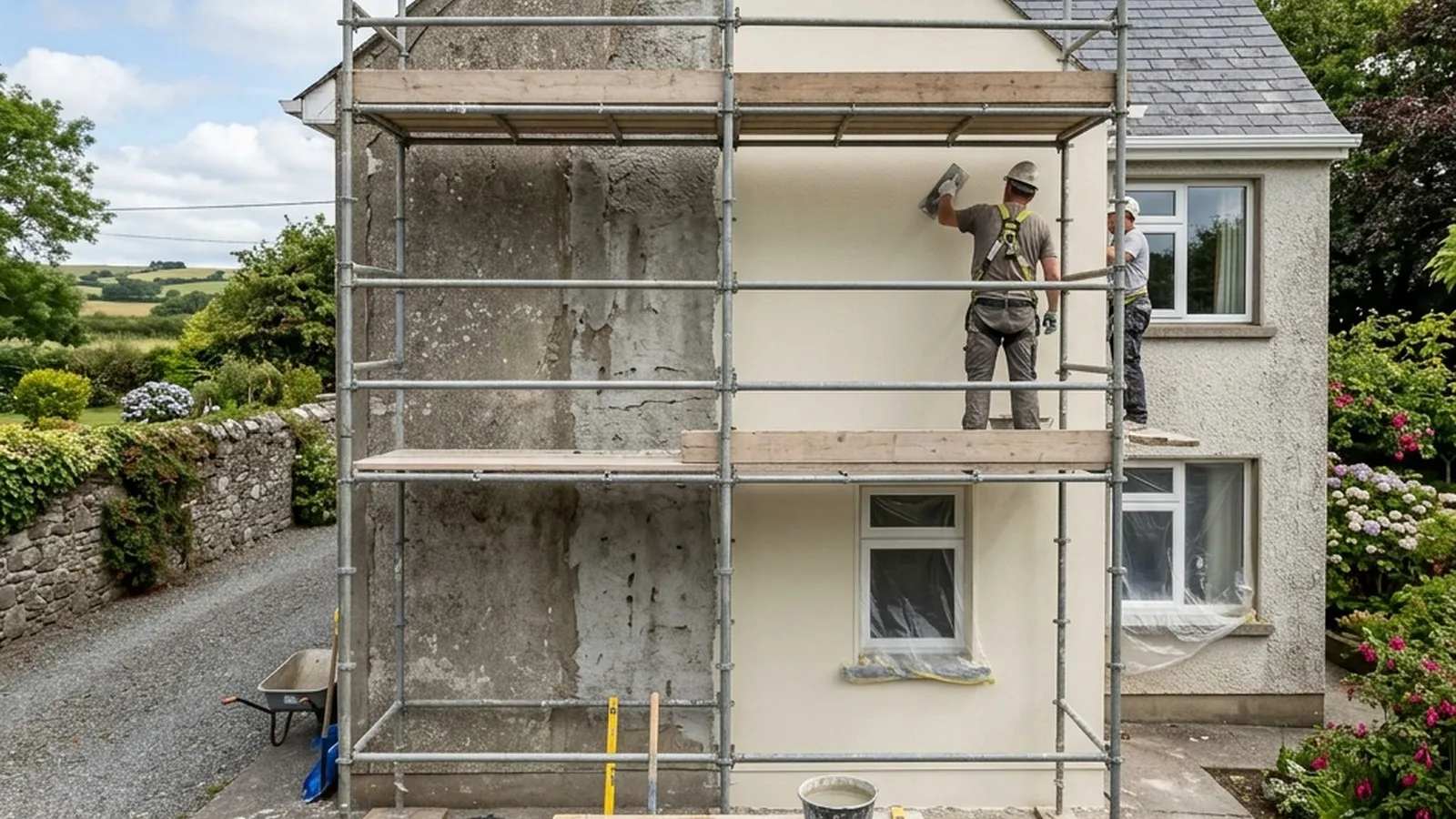
The useful rendering budget is the total for a specified job on your own walls. A price per square metre is only comparable when it covers the same area, preparation, finish and access. We do not have a verified current national price series for rendering, so this guide gives you a quote checklist rather than an unsupported average.
What should the quote include?
Ask contractors to price the same schedule. Keep optional work and uncertain repairs separate so you can see what would change the final bill.
| Quote item | Detail to request |
|---|---|
| Wall area | Elevations included, how openings are deducted, and treatment of reveals and gables |
| Existing finish | What stays, what is removed, disposal and how the exposed wall will be assessed |
| Repairs | Known defects, investigation needed and how additional repairs will be agreed |
| Render or cladding system | Named product and complete build-up, finish, colour and junction details |
| Access and protection | Proposed working platform, hire period, protection of windows and neighbouring areas |
| Services and edges | Treatment of pipes, vents, cables, sills, eaves and connections to adjoining finishes |
| Completion | Making good, cleaning, waste removal, VAT, payment stages and warranty documents |
A low headline rate can leave expensive parts outside the quote. Ask for an inclusive total and a written list of exclusions. If a contractor cannot price hidden repairs until removal, agree how that additional work will be measured, authorised and charged.
Repair, repaint or replace?
Start by identifying why you want the work: appearance, loose finish, cracking, damp or an insulation upgrade. Ask whether the existing finish can be retained and repaired. If it is sound, compare a repair-and-decoration proposal with full removal; our painting-cost guide helps organise the decoration scope.
Do not ask a new finish to conceal an unexplained defect. Have the cause of persistent damp or significant cracking investigated before choosing a replacement. Request photographs and a clear repair specification, especially where the contractor expects to uncover further damage.
Choose a system, not just a finish label
Terms such as sand-and-cement, silicone render, acrylic render, brick slips and timber cladding are not complete specifications. Ask the designer or contractor why the proposed system suits the existing wall and exposure, and request its installation and maintenance instructions.
Compare how openings, movement joints and changes of material will be detailed. For cladding, ask what support, cavity and junction work the quotation includes. Agree a sample finish where appearance matters, and record the colour and texture before ordering.
Avoid a generic promise of decades without maintenance. Compare the actual warranty, exclusions, cleaning or repainting requirements, and how local damage would be repaired. This guide does not assume that one finish is always cheapest to install or own.
Assess insulation before agreeing the finish
SEAI’s wall-insulation guidance describes external insulation as insulation fixed to the outside of the wall. A new decorative render coat alone is not that measure.
If insulation is appropriate, request a separate complete-system proposal while planning the finish. Compare the additional scope and final price; sharing access work does not establish an automatic saving. SEAI requires a whole-surface wall solution for grant eligibility, a contractor registered for the work and approval before works start. Its guidance also flags possible ESB Networks service alterations. Ask who will arrange and price those where needed.
Use the wall-insulation options guide to prepare questions, then check the official conditions and your grant offer. The grant checker is a starting point for discussion, not approval. For help managing a larger project, compare One Stop Shop and individual routes.
Take a different approach to traditional walls
A traditional solid-wall home needs advice suited to its construction. Do not select a modern finish solely because it is described as breathable. Ask how the whole proposed wall build-up will manage moisture and whether existing materials should be retained or repaired.
SEAI’s Traditional Homes guidance explains why compatible materials, remedial work and conservation experience matter. Its pilot requires an appropriate traditional-building professional to oversee the upgrade. Discuss suitability before obtaining a final render or insulation specification.
Access belongs in the budget
Ask the contractor to specify the access method and protection for occupants and passers-by. Do not assume a lower wall can safely be rendered from a ladder just to reduce cost. The Health and Safety Authority’s construction guidance stresses planning, risk assessment and appropriate equipment for work at height.
Confirm how weather delays affect the programme and access hire, and who deals with any permission needed for access outside your property. Put those responsibilities into the quote.
Your next step
Prepare photos of each elevation and a list of defects, existing finishes and planned future upgrades. Obtain comparable written proposals, resolve uncertain repairs and check the payment and warranty terms. Keep the agreed scope with the final product documents and completion records. Our renovation hub covers related work when you are coordinating several jobs.