
After attic insulation, wall insulation is the most impactful energy upgrade for most Irish homes. Walls account for roughly 25–35% of heat loss in a typical uninsulated house.
Which type applies to your home?
| Wall type | Typical homes | Solution |
|---|---|---|
| Cavity walls (unfilled) | 1940s–2000s brick/block | Cavity fill (cheapest) |
| Cavity walls (already filled) | Most post-1990s new builds | May already be done |
| Solid stone/concrete walls | Pre-1940s, rural cottages | Internal dry-lining or EWI |
| Single-skin block | Some 1960s–70s bungalows | Internal or external |
Cavity wall insulation
Cavity fill involves drilling holes in the outer leaf of the wall, injecting insulation (usually EPS beads or mineral wool), and sealing the holes. Work is done externally and takes one day with minimal disruption.
Grant amounts:
| Dwelling | Standard | Welfare |
|---|---|---|
| Detached | €1,800 (manual, 2026-06-12) | €2,300 (manual, 2026-06-12) |
| Semi / end-terrace | €1,300 (manual, 2026-06-12) | €1,700 (manual, 2026-06-12) |
| Mid-terrace | €850 (manual, 2026-06-12) | €1,100 (manual, 2026-06-12) |
| Apartment | €700 (manual, 2026-06-12) | €900 (manual, 2026-06-12) |
Typical cost: €1,000 (historical estimate, manual, 2026-06-12)–€2,000 (historical estimate, manual, 2026-06-12) installed before grant.
Watch out for: Homes in very exposed coastal areas or with defective external render may not be suitable for standard cavity fill. Partial fill may be needed. A surveyor will assess suitability.
Internal wall insulation (dry-lining)
Internal dry-lining attaches insulated plasterboard (or a framework with insulation between) to the inside of external walls. This is the main option for solid-walled homes and where cavity fill isn’t possible.
Grant amounts:
| Dwelling | Grant |
|---|---|
| Detached | €4,500 (manual, 2026-06-12) |
| Semi / end-terrace | €3,500 (manual, 2026-06-12) |
| Mid-terrace | €2,000 (manual, 2026-06-12) |
| Apartment | €1,500 (manual, 2026-06-12) |
Typical cost: €3,500 (historical estimate, manual, 2026-06-12)–€8,000 (historical estimate, manual, 2026-06-12) for a semi-detached home. More disruptive than cavity fill, as skirting boards, electrical outlets, and door frames need to be moved.
Disadvantage: Reduces room size by 75–100mm per wall. Rooms need to be emptied and redecorated.
External wall insulation (EWI)
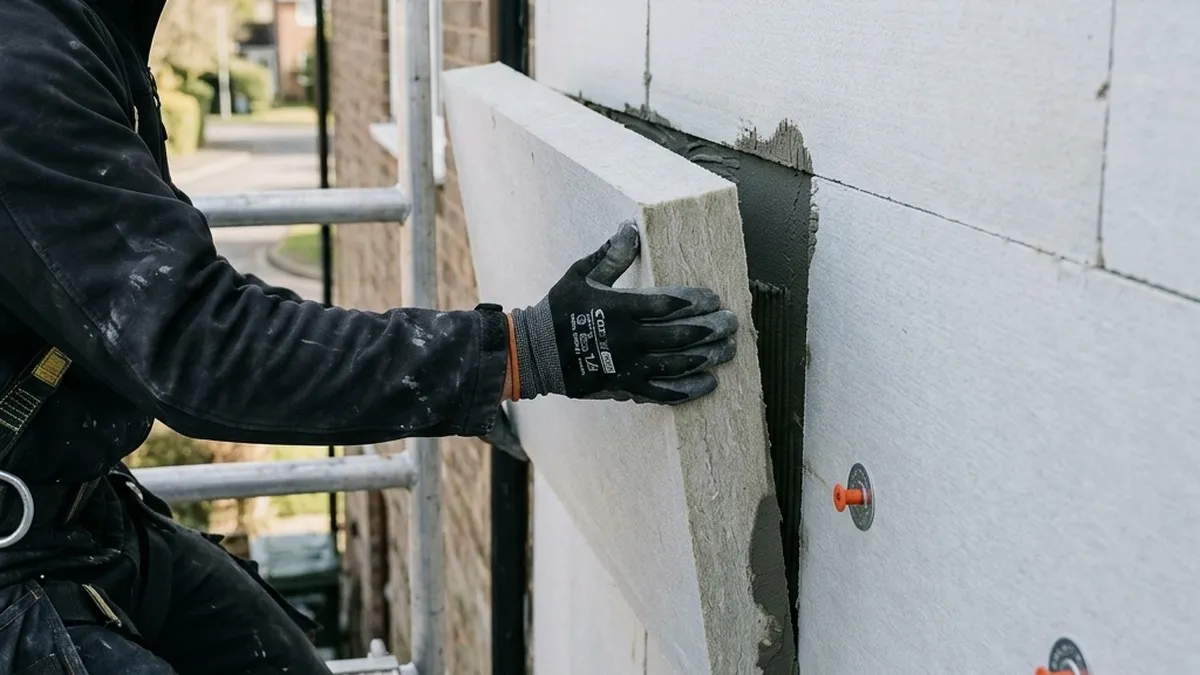
EWI involves attaching rigid insulation boards to the outside of the home and rendering or cladding over them. This is the most comprehensive wall insulation solution, improving thermal performance, weatherproofing, and appearance simultaneously.
Grant amounts:
| Dwelling | Grant |
|---|---|
| Detached | €8,000 (manual, 2026-06-12) |
| Semi / end-terrace | €6,000 (manual, 2026-06-12) |
| Mid-terrace | €3,500 (manual, 2026-06-12) |
| Apartment | €3,000 (manual, 2026-06-12) |
Typical cost: €15,000 (historical estimate, manual, 2026-06-12)–€30,000 (historical estimate, manual, 2026-06-12) for a detached home. A €8,000 (manual, 2026-06-12) grant makes a significant dent but EWI remains a major investment.
Benefits over internal: No room size reduction. All walls treated (including thermal bridges at corners and lintels). Often combined with new windows and external doors for a full retrofit.
Which should you choose?
| Cavity fill | Internal (dry-lining) | External (EWI) | |
|---|---|---|---|
| Disruption | Very low | High | Medium |
| Cost (net) | Low | Medium | High |
| Room impact | None | Small reduction | None |
| Suitable for solid walls | No | ✓ Yes | ✓ Yes |
| SEAI grant | Good | Good | Excellent |
| Best value | ✓ Best | Good | High impact |
Recommendation for most Irish homes:
- Cavity walls → start with cavity fill
- Solid walls or cavity not suitable → internal dry-lining
- Major retrofit or energy efficiency target → external wall insulation
Combining EWI with attic insulation and a heat pump is the route to achieving a B-rated home.
Grant amounts for each measure are in the insulation grants guide, and the eligibility checker will confirm what your home can claim.