
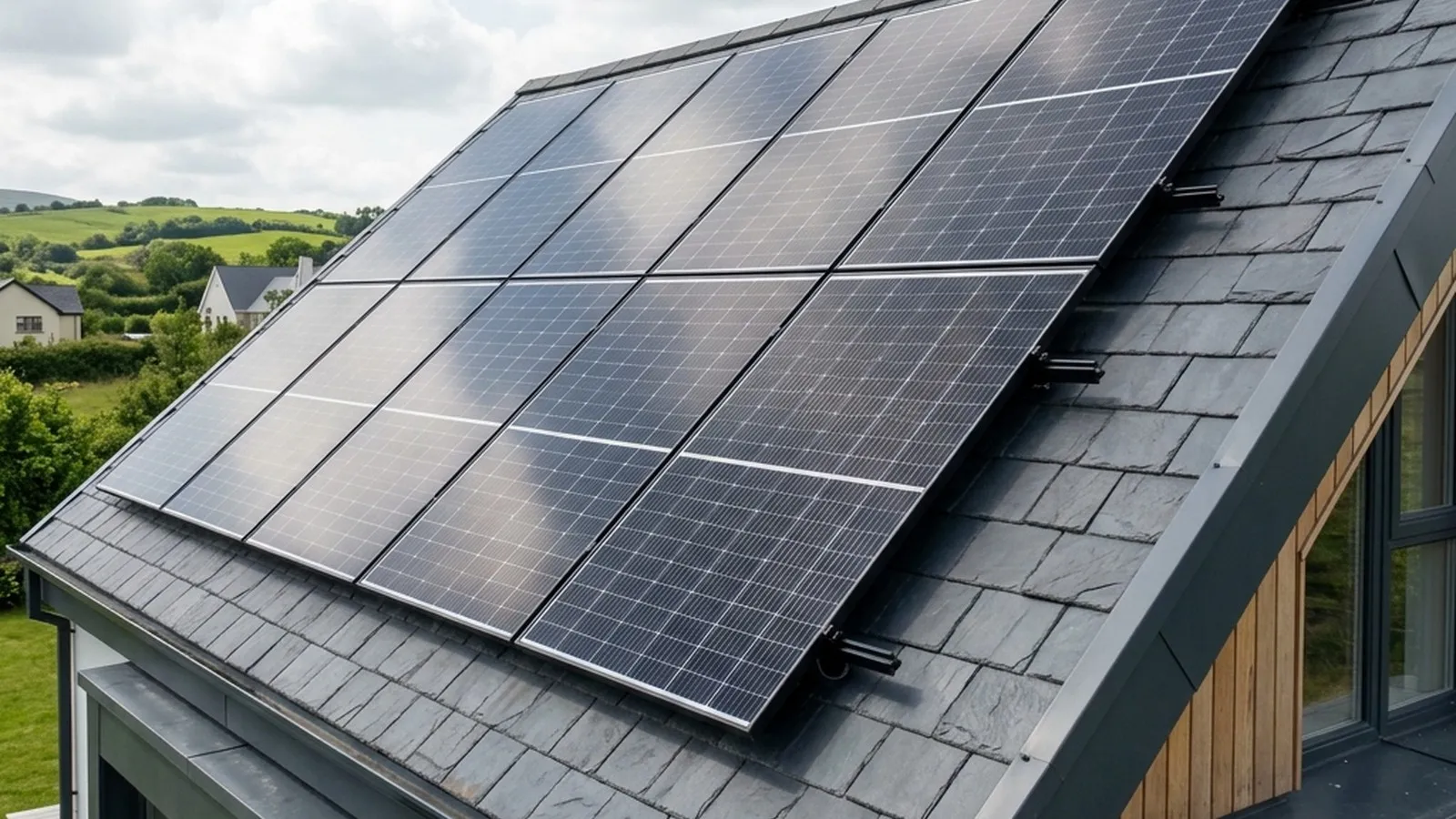
If you are putting solar panels on the roof of an ordinary house in Ireland, the short answer in 2026 is that you almost certainly do not need planning permission. Since the October 2022 planning changes, rooftop solar PV and solar thermal panels on houses are exempted development, and the old area cap (12 m² or 50% of the roof) was removed entirely. You can now cover as much of your roof as you like. The main situations where permission is still required are protected structures, Architectural Conservation Areas (ACAs), and larger ground-mounted arrays. This article explains where the exemption applies and where it stops.
A quick disclaimer
This is general guidance, not legal advice. Planning law turns on the specifics of your property, and only your local authority can give a definitive answer. If you are in any doubt — particularly for older, period, or boundary-line cases — you can apply for a Section 5 declaration, which is a formal ruling from the council on whether your proposed works are exempted development.
The general rooftop exemption for houses
The 2022 regulations (made under the Planning and Development Act 2000) made rooftop solar on houses exempt with no overall area limit. The conditions to watch are about how the panels sit on the roof rather than how many you install:
- Panels on a pitched roof must not project more than 15 cm above the roof plane.
- Panels on a flat roof must not project more than 50 cm above the roof.
- Panels must be set back at least 50 cm from the edge of the roof.
Stay inside those conditions on a standard house roof and the install is exempt — there is no need to notify the council at all. This is what makes most domestic solar a straightforward job. If you are weighing up the numbers, our solar panel cost guide for Ireland walks through typical system prices and payback.
The exceptions to watch
The exemption does not cover everything. You should expect to need planning permission, or at least confirm your position with the council, if any of these apply:
- Protected structures. If your home is on the local authority’s Record of Protected Structures, the exemption does not apply. You will normally need permission, and the council will look closely at visual impact.
- Architectural Conservation Areas. Homes within an ACA face additional restrictions designed to preserve the character of the area, so the standard exemption may not hold.
- Solar safeguarding zones. These are areas around airports, aerodromes, and helipads where glint and glare from panels could affect aviation safety. Importantly, there is no rooftop limit on houses even inside one of these zones — the rooftop area cap (in the region of 300 m²) bites on apartments and other building types, not on houses. If you live near an airfield it is still worth a quick check with the council.
If you are unsure which of these applies to you, the council’s planning section can tell you whether your address is a protected structure, in an ACA, or in a safeguarding zone.
Ground-mounted arrays
Free-standing (ground-mounted) panels in your garden are treated more strictly than rooftop ones. For a house, the exemption applies only within these limits:
- Total area no more than 25 m².
- No higher than 2.5 m at the highest point.
- Not positioned forward of the front wall of the house.
- At least 25 m² of private open space must remain after installation.
Go beyond any of these and you will need planning permission. If you are also planning other garden structures, the same exempted-development logic applies — see our note on garden room planning permission for how these rules interact.
Apartments and other buildings
Apartments are not covered by the house exemption. The 2022 changes did introduce, for the first time, a rooftop exemption for apartments and certain non-domestic buildings, but with their own conditions and an area limit that can apply in solar safeguarding zones. In practice, apartment roofs are shared structures and common areas, so you will usually need the management company’s consent and, depending on the building, may still face a planning step. If you live in an apartment, start by talking to your owners’ management company before anything else.
What still applies even when planning is exempt
Being exempt from planning permission does not mean there are no rules at all. Two things still apply to every install:
- Building Regulations and safe electrical work. The installation must be structurally sound and electrically safe. Solar PV connection work is electrical work that must be carried out by a registered electrician and certified appropriately.
- ESB Networks notification and grid connection. Before a grid-connected system is energised, your installer must complete the NC6 notification to ESB Networks. This is separate from planning and is required regardless of the size of your system. Microgeneration up to the standard domestic threshold is handled through this notification process rather than a full connection application.
Using an SEAI-registered installer keeps you on the right side of both. That is also a condition of the grant — see our SEAI solar PV grant guide for who qualifies and how to apply. Once installed, you can also earn for the electricity you export; our solar payback and Clean Export Guarantee article explains how that side of the maths works.
The bottom line
For the typical Irish house in 2026, rooftop solar is exempt from planning permission with no area cap — a major simplification from the pre-2022 position. Keep the panels within the roof-edge and projection limits, use a registered installer, and make sure ESB Networks is notified. The only times you need to pause are protected structures, conservation areas, larger ground arrays, and apartments. When in doubt, a quick call to your local authority — or a Section 5 declaration — will settle it.