
Budget from an itemised quote for your own property. Confirm the specification, site preparation, VAT and exclusions before comparing prices. The scope below identifies work to price; it is not a current national price average.
The right figure depends entirely on which type of damp you have — so diagnosis comes first.
The three types of damp — and why diagnosis matters
The single most common mistake is treating the wrong problem. There are three distinct types of damp, and an expensive damp-proof course will do nothing if the real issue is condensation.
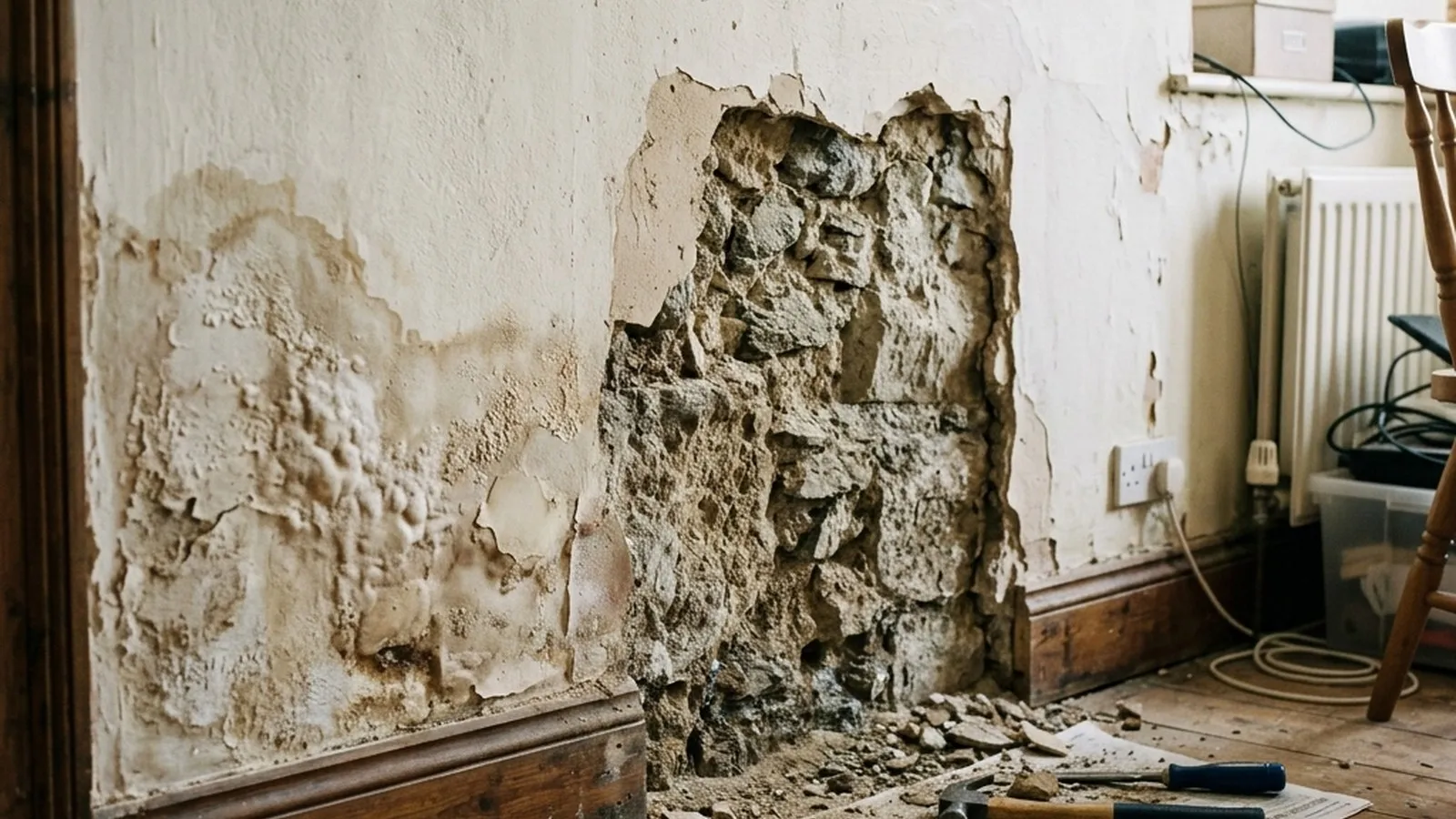
- Rising damp — groundwater drawn up through the masonry where there is no damp-proof course (DPC) or where an old one has failed. It shows as a tide mark, white salt deposits and peeling plaster on the lower part of walls, usually below about a metre. It is common in older Irish homes with solid stone or block walls built before DPCs were standard.
- Penetrating damp — water entering through an external defect: cracked render, failed pointing, a leaking gutter, a slipped slate or a faulty window seal. It can appear at any height and often gets worse after heavy rain. The fix is the external repair, not injection.
- Condensation — warm, moist indoor air meeting cold surfaces. It produces black mould around windows, in corners, and in bathrooms and kitchens. It is the most common damp complaint in Irish homes and is usually solved by better ventilation and heating, not chemical treatment.
Some surveyors hold a CSRT/PCA-type qualification; an independent survey avoids being sold treatment you do not need.
Damp proofing cost table
| Treatment | Project-specific range |
|---|---|
| Damp survey | Quote required |
| Chemical DPC injection (per linear metre) | Quote required |
| Rising damp — single wall (DPC + replaster) | Quote required |
| Rising damp — standard semi-detached house | Quote required |
| Rising damp — larger / detached house | Quote required |
| Penetrating damp — minor external repairs | Quote required |
| Penetrating damp — extensive structural work | Quote required |
| Condensation / ventilation (extractor fans, PIV) | Quote required |
| Salt-resistant replastering | included in DPC quotes; itemise separately |
| Basement / cellar tanking | Quote required |
These are project-dependent quote items only. Damp work is priced by wall length, condition and access, so always get at least three written quotes after each contractor has surveyed the property.
Rising damp: DPC injection and replastering
The standard fix for rising damp is a new chemical damp-proof course — a water-repellent cream or gel injected into a line of holes drilled along the base of the wall, forming a barrier the moisture cannot cross.
The bigger cost is often the replastering. Rising damp carries ground salts into the plaster, and those salts keep absorbing moisture from the air long after the wall is dry. If ordinary plaster is reused it will bubble, stain and blow again. The affected plaster must therefore be hacked off and replaced with a salt-resistant (renovating) render, then allowed to dry before redecorating. Make sure quotes itemise injection, replastering and making-good separately — see our replastering cost guide for what that element should cost.
Penetrating damp and condensation
Penetrating damp is fixed by curing the source: repointing, patching render, clearing or replacing gutters and downpipes, sealing around windows, or roof repairs. Minor work can be a few hundred euro; serious render or structural repairs run into the thousands.
Condensation is the cheapest to address and the most often misdiagnosed. Solutions range from a quiet humidity-sensing extractor fan to a whole-house positive input ventilation (PIV) unit, alongside steadier heating and reduced moisture from drying clothes indoors. Better insulation also raises wall surface temperatures so moisture is less likely to condense — relevant if you are weighing up internal wall insulation or reviewing wall insulation types. Tackling damp and condensation together typically improves both comfort and your BER rating.
Ways to save
- Diagnose before you treat. Pay for an independent survey; do not buy a DPC to fix what is actually condensation.
- Fix the cheap causes first — clear gutters, repoint, improve ventilation. Many “damp” walls dry out on their own once the real source is removed.
- Itemise the quote so injection, replastering and external repairs are separate and comparable.
- Bundle the work. If you are already doing a larger project, fold damp work into the whole-house renovation budget to share scaffolding and trades.
When to call a specialist
Call a damp specialist if you see a persistent tide mark and salting on lower walls, if mould keeps returning after cleaning, if there is a musty smell, or if plaster and skirting are perished. Get the diagnosis in writing, insist on at least three quotes, and check the contractor offers a meaningful guarantee on any DPC work. For solid-walled older properties especially, see our notes on heat pumps in older homes, as damp, insulation and heating decisions are best planned together.